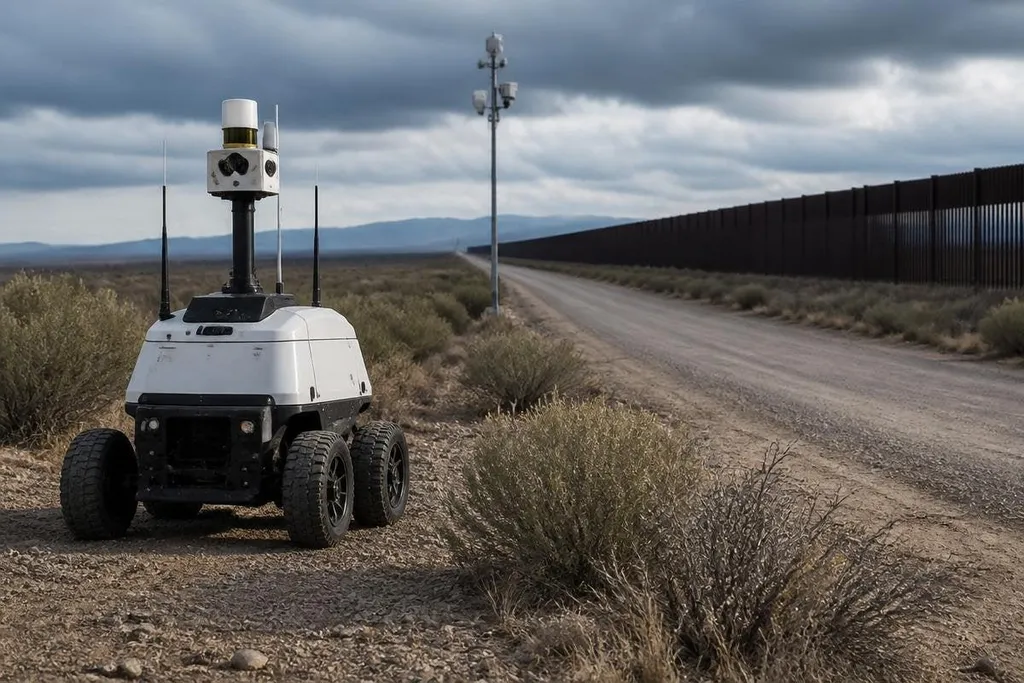
A border robot may spend hours watching an empty road, then flag one moving shape in poor light. AI changes the job by sorting sensor data and asking a human to review the cases that need attention.
This matters to an agency choosing patrol robots, fixed cameras, or remote ground vehicles. The useful question is not whether a robot has AI. It’s what the software can detect, what it misses, and who checks the result.
Quick read
- AI can sort camera, thermal, radar, and location data before a person reviews it.
- A human still needs to confirm uncertain alerts before officers act.
- Weather, terrain, privacy rules, and weak network links can limit a robot’s value.
Where AI fits in the robot
A border robot gathers data through sensors. A camera records visible light, a thermal sensor reads heat, radar measures movement, and a location system records where the robot is.
AI software studies those inputs and labels patterns such as a person, vehicle, animal, or fallen branch. That label helps the robot decide what deserves attention.
A patrol unit can send a short alert instead of a full video stream, which may reduce the data sent over a weak radio link. The system can also mark a route for review after the robot returns.
This process is called perception. In plain terms, the robot turns raw sensor readings into a best guess about what sits in front of it. A best guess is not proof, so the software should show the image, sensor view, location, and confidence level to the operator.
AI can also help with movement. A robot may use cameras and LiDAR to map nearby ground, spot rocks or steep slopes, and choose a path around them. That does not give the robot judgment about people or legal action. It gives the robot a way to move while a person remains responsible for the mission.
What changes for border teams
The main change is the amount of data a team can review. A person who watches every camera feed may miss a small event after hours of quiet footage. Software can mark clips that match a set rule, then leave the final decision to a trained operator.
For an agency weighing a patrol robot, border security robotics reporting from Robot24.com can connect an AI claim to the sensor, test site, date, and operator’s role. That context matters when the next question is who stores the footage and how long it stays available.
The same system can create a record of what the robot saw and when it saw it. That record may help an agency review a patrol, check a false alert, or find a sensor failure. It also raises a direct question: how long should the agency keep the video, and who can access it?
AI does not remove the need for staff. Teams still need people to set alert rules, review edge cases, maintain sensors, check maps, and respond when the network fails. A robot that finds an object but cannot send its location in time has not solved the field problem.
Where the system can fail
AI performance depends on the data used to train and test it. A model that works on clear daytime footage may make more mistakes in rain, snow, dust, fog, glare, or low light.
Terrain changes the view too. Grass, rocks, fences, and shadows can look like movement.
False alerts consume staff time. Missed alerts carry a different risk because a team may assume the software would have flagged a person or vehicle. The agency needs records of both types of error, separated by weather, sensor type, location, and time of day.
Network loss creates another limit. A remote robot may continue a safe stop routine, return along a known route, or wait for a link to return. Those actions need clear rules before deployment, especially where a moving vehicle could meet people or other vehicles.
Privacy needs equal care. Cameras and thermal sensors can collect information about people who are not part of an incident. Access controls, retention periods, audit logs, and human review should be part of the system design rather than added after the robots arrive.
A buying checklist
Before approving a border security robot with AI, check these points:
- Name the task: Decide whether the robot will watch, map, carry a sensor, or move along a route.
- Test local conditions: Run trials in the actual terrain, weather, light, and network areas.
- Measure errors: Record false alerts and missed events, then set a review process for each.
- Keep human control: Define who confirms an alert and what action the robot may take without approval.
- Plan failure modes: Test lost communication, low battery, blocked sensors, and damaged wheels.
- Set data rules: Decide who can view recordings, how long they remain stored, and when they are deleted.
I’d reject any purchase that gives a detection score without showing how the score was measured in the place where the robot will work.
The next useful proof is a field report with sensor results, alert errors, network outages, and operator workload from one defined border area. Until agencies publish those details, AI can sort patrol data, but its value still depends on the people, rules, and tests around the robot.